
01 The Listeners - Jeffrey Smart
Jeffrey Smart, Royal Park and the Sublime

Perhaps it’s a strange thing to say, perhaps not, but I love bizarre, unusual meteorological conditions. There is something totally captivating, yet ineffable about them. Something that is beyond words.
I think of miscoloured afternoon skies, or 22° moon halos during the late freezing hours of winter nights. Of distant, isolated rain shafts driving opaque columns down to the earth. Of lightning sprites, false horizons out at sea…
Pleasantness here is irrelevant. It is not that I don’t value pleasant weather or the bodily comfort it brings, but the conditions in question excite a feeling that is altogether outside of pleasantness.
There is something in the strange, dreamlike moments we are graced with uncanny weather, that conjures some resonance within my soul. It’s like encountering the earth altogether anew. If I had to locate the feeling within my body, I’d describe it as a peaceful eruption of energy in my chest, just below my heart. Perhaps you could call this an aesthetic experience.
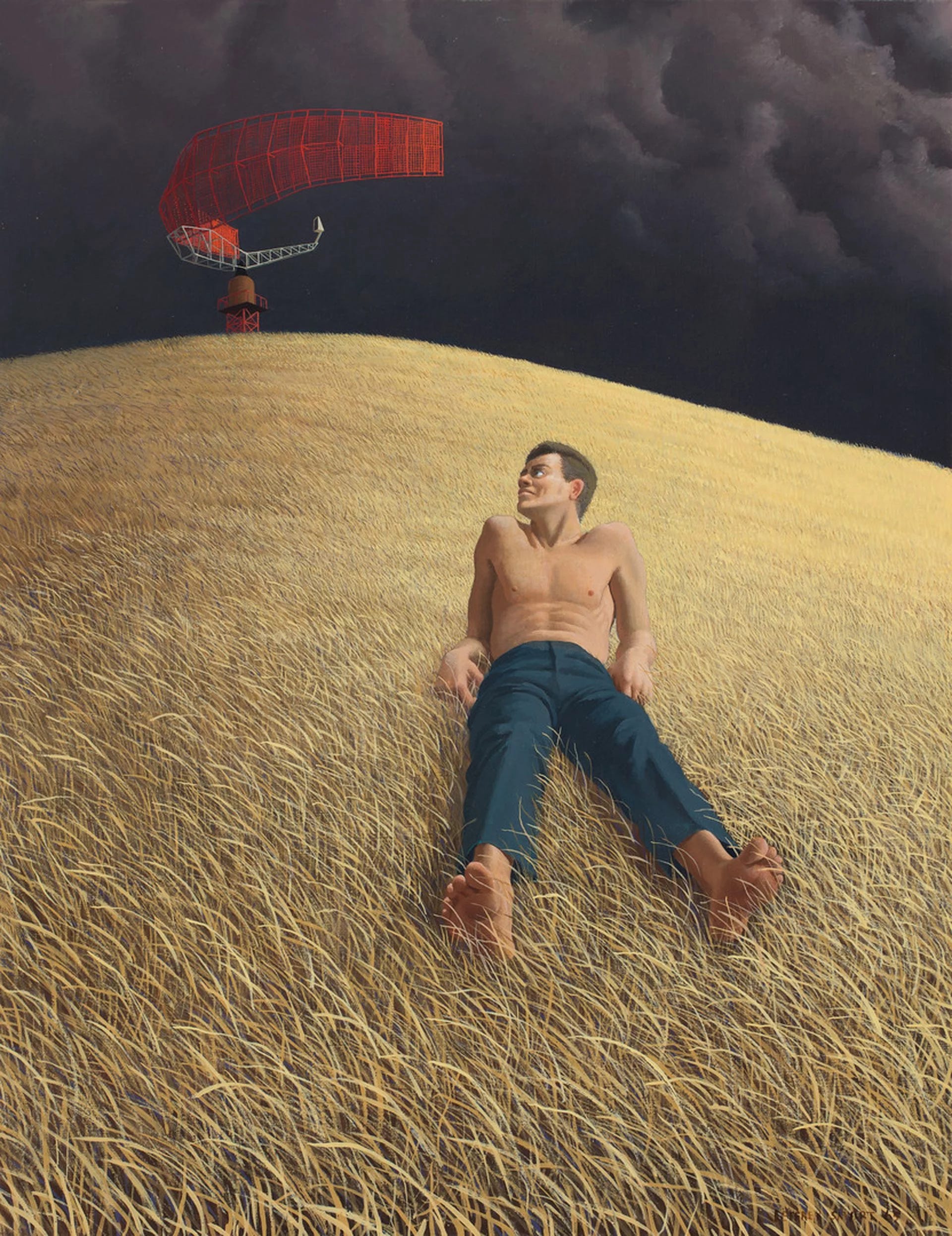
I was immediately struck by this very feeling on my first encounter with Jeffrey Smart’s haunting 1965 painting, The Listeners.
If you gaze upon this work, you are met with a rather eerie scene, staged with exquisitely strange weather. In the foreground you find the figure of a shirtless man, lying in long, brown grass. He is positioned on the side of a hill that rolls upwards into the background. Just left of the hill’s apex is a large red radio antenna. Together, they form two focal points in the image. The man has turned his head and tilted it towards the antenna behind him. It is unclear if he is able to see it or not, perhaps he is somehow listening to it, as the title of the painting seems to suggest. His face frozen in an expression of concentration, his disposition is otherwise ambiguous. Maybe he is paranoid, or lonely. Maybe he is intrigued. I originally perceived his face as crazed, now I am not so sure. He is alienated from those viewing the painting. His behaviour is decisively obscure.
The hill is entirely covered in a thick blanket of long, brown grass. It is warmly illuminated from an extremely low angle, as if caught in a sunset. Overhead, however, the clouds have no warmth at all. They are dark and heavy, almost dark enough to be a night sky or that of a storm. This highly peculiar quality of light renders the landscape in an otherworldly glow. There is a sense of surrealness, which is reinforced by the curiously empty setting, and the seemingly artificial homogeneity of the grass. This isn’t an image of a real place, or at least it doesn’t seem like one. Nonetheless it is strangely familiar.
I am struck by the sense that I have been to this expansive, unreal landscape at some point before. As if, I have lived through this very same uncanny sunset, standing on some version of this very same hill.
Perhaps there really is something familiar about this place. While it was painted after Smart had moved to Rome in 1964, it nevertheless has the same eerily emotive qualities that can be found in overlooked parts of many Australian cities. It evokes memories of parks, edgelands, formerly industrial estates, easements. All replete with the same sense of endless grassy expanse, intruded upon by some urban or infrastructural motif.
Whenever I encounter The Listeners, I find that it always evokes the memory of one place, in particular. A place that has haunted me for some time: the Native Grassland Circle of Royal Park. As the name suggests, this is essentially an immense expanse of grassland bound by a circular footpath. It is situated just northwest of the CBD in Melbourne, in the suburb of Parkville.
The first time I came across the Circle was in the early months of 2018. Around this time, several good friends of mine had just moved into a rather dilapidated house on Boundary Road, at the edge of North Melbourne. On a late Autumn afternoon, under an overcast sky that rendered everything in a dull pale shade of its natural colour, I received a message inviting me to visit.
I had just started an honours year at the University of Melbourne, after previously studying at Monash, and had been couped up in one of the university’s libraries when the message came through. Since the campus was only one suburb away from the house, I decided to walk over.
On my way I realised that the area was still quite unfamiliar, and I had no idea how long the walk would take nor the places it would lead me through. I can still recall deliberating whether to make my way along Flemington Road, or to turn and enter into the parkland that lay on the other side of Gatehouse Street. Fortuitously I opted for the latter.
Passing the bounding layer of trees and bushes, I entered an immense clearing, whereupon I found myself in the Circle for the first time. It felt like I had entered a new world altogether. One that superficially appeared to be the same, but was nonetheless completely novel and distinct from the world I had just left. I noticed the expanse first and foremost, and the shape of the field. Then I noticed the sky. It appeared to lie closer to the earth. The clouds had begun to break apart into monumental islands, allowing evening sunlight to puncture through.
The experience was almost dizzying. It seemed like space had become more intensely hyperbolic, unusually magnified and foreshortened. I walked a lap around the circle. As I passed along the north-western segment I saw the towering skyline of the Central Business District. Like the sky, it seemed impossibly close. You might call the experience some kind of encounter with the sublime…
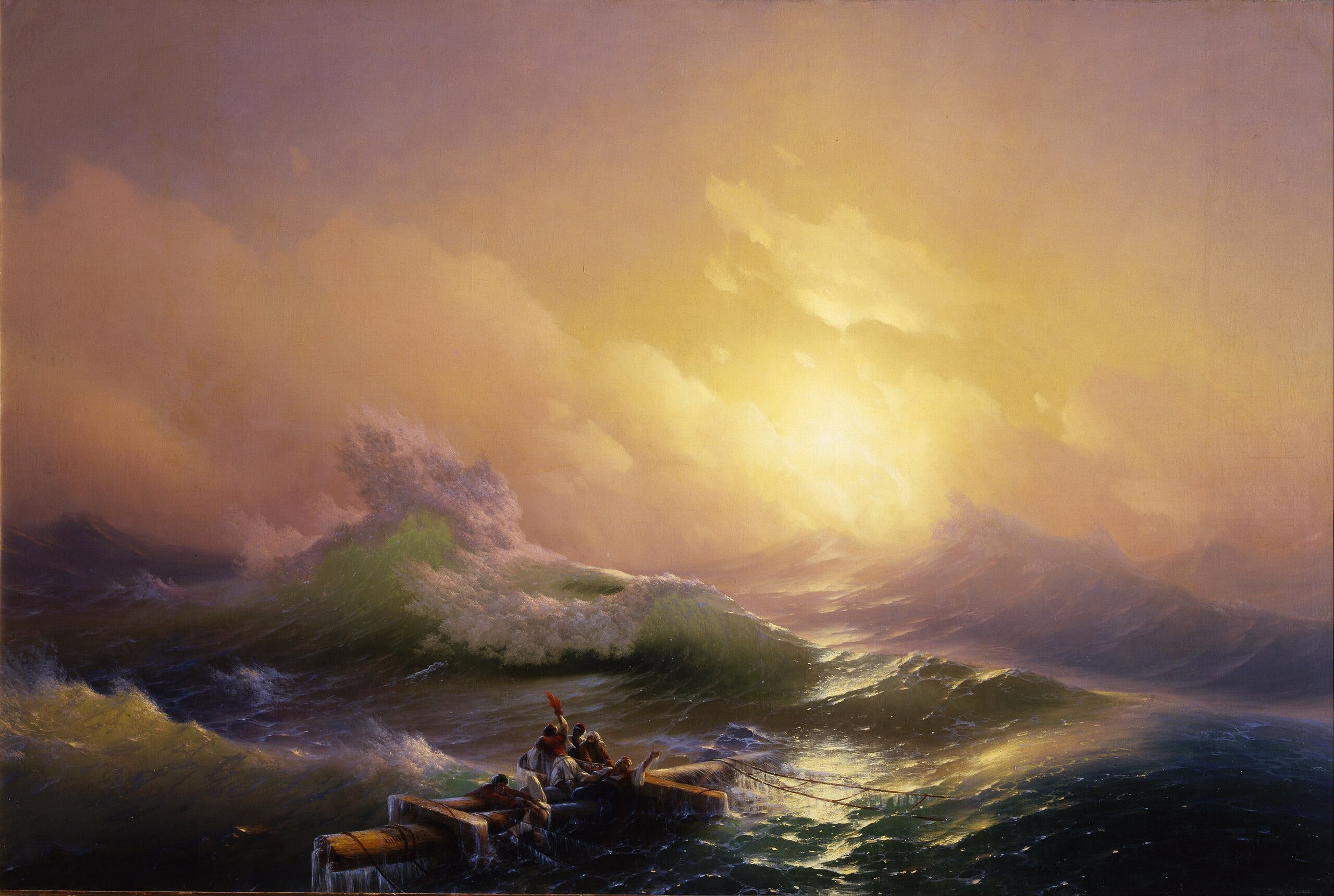
This may seem to be archaic descriptor, these days. Certainly it is an old term that I don’t hear being used too often. It came to predominance in the 18th Century, and seemed to have powerfully penetrated the consciousness of the Romantics in the century that followed. At this time, it was considered a state of being totally overwhelmed, both psychologically and spiritually. Edmund Burke, who took it upon himself to define the term, found it to be a form of terror. He described the sublime experience as a “state of the soul in which all its motions are suspended, with some degree of horror.” For Immanuel Kant It was a state which arises when the intellect is so overwhelmed, by something of such immense magnitude or force, that all it can perceive are its own limits. Generally, it was noted to be an intoxicating, awe-inspiring, horrifying state, usually provoked by some extraordinary view. Powerful storms, distant horizons and immense mountain ranges come to mind. Ivan Aivazovky’s evocative 1850 painting, The Ninth Wave, serves as one of the most effective representations of this idea.
This, however, is not necessarily the same sense that I think of when I encounter the native grasslands circle. Certainly there remains that feeling of intoxication, being overwhelmed. But it is more uncanny, more dreamlike, more complex and indirect. It is that same ineffable sense of otherworldliness that arises when I encounter strange weather. You might label it as a contemporary version of the sublime.
No other work of art recalls the uniquely contemporary sublime experience of visiting the Native Grassland Circle more effectively than The Listeners. Like the Circle, there’s something subtly peculiar about the sense of space in the painting.
The more you look at it, the more the foreground appears magnified, while the space of the background becomes confused and warped. The feet of the figure lying in the field seem to protrude out beyond the surface of the image. Around his feet, each individual blade of grass is rendered in high definition, their shapes betraying the direction and turbulence of an unseen breeze. It blows in from the distant reaches of this immeasurably large field, far beyond the edge of the frame. The grass continues to the base of the painting, and seemingly beyond. You almost find your body constituted within the scene, the field appears to engulf you. By contrast, you cannot clearly gauge the scale of the antenna. Or even the distance to the top of the hill. It is so sparse, so empty, but you are aware of something ever present that you cannot see and cannot understand.
Here, ineffability abounds. Everything is perpetually out of reach and sublime. The content of the painting offers no information beyond what is already given in the title. The man’s head is turned, so too is the antenna. Both are engaged in the invisible act of listening.