
07 Hand Drawing in Architecture
Reflections on 'Letting Things Rest' and contemporary design practice

It is an overcast day in the Central Business District. The digital clock on my phone screen tells me that it’s some time after 1pm. The year is 2025, and the month is March. A party of two, myself and a friend, walk down spring street, dodging an expensive-looking wedding reception as it spills out of the Hotel Windsor. As soon as we find ourselves in line with the old treasury building and the striking modernist office complex behind it, we turn and make our way down Collins Street.
We are not walking long when we arrive at our destination, 12 Collins Street, an early 20th century office building that looks to be four, or five, stories tall. A plaque by the door reads: ‘Victor Horsley Chambers’. And underneath the heading, a caption: “Designed by architects Blackett and Forster in 1924 for Victor Horsley of Horsley and Evans Costume Manufacturers as an investment office building”. The plaque appears to designate the building as being of heritage significance. It is deep blue in colour, approaching navy, with a glossy finish and white lettering. I find the last line particularly salient: “the Chambers are a finely detailed example of the Georgian Revival Style”. For a moment we double-check that this is, indeed, the right place. Then we walk inside.
We have been invited to attend an exhibition titled, Letting Things Rest, located in a suite on the upper floors. Passing through the vestibule, we find ourselves in the hallway of a rather charmingly antiquated office interior. Everything is warmly coloured in earthy wooden hues and there is a streamlined sense of ornateness, most evident in the mouldings and the rather lovely parquetry floor. It even has its own walled-off concierge booth. This is a workplace that seems far removed from the seemingly inescapable array of homogenous, newly built offices, with their open plan layouts, exposed ceiling services and general wash of stylised industrial greyness. For this reason, it is all the more delightful.
The exhibition consists of a collection of fragments, each presenting some part of a different architectural project. There are sketches, measured drawings, models and composite images. Along with a short accompanying didactic featured in the exhibition’s catalogue, each fragment serves as the only point of entry to the project it displays.
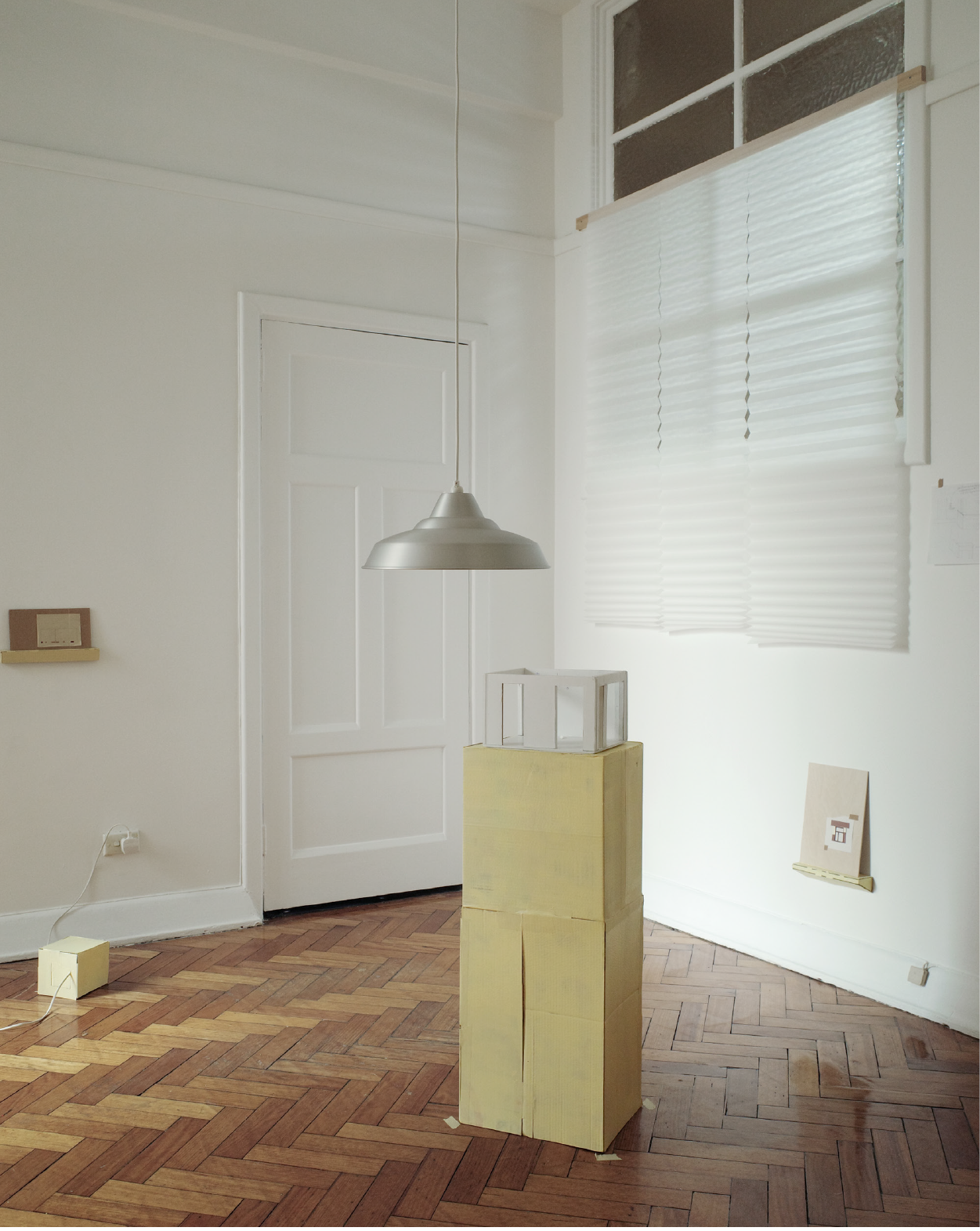
The work shown is by Colby Vexler, Kate Finning, Jean Marc Tang, Ieva Davulyte and Andrew Power. Like myself and my friend, they have chosen architecture as their profession. All but one of the listed designers actively practice in Melbourne, and all designers work in a generally shared sphere of interests, leveraging similar methods of design, and aspiring towards similar definitions of ‘good architecture’. You might be tempted to call it a shared style, but they remain deliberately nebulous whenever the task of self-defining comes up.
A brief introduction, written by Jean Marc Tang, clarifies that the pieces shown “are not ‘work in progress’ documents that contrast with built artefacts in some retrospective analytical enterprise, but, as it were, live projective entities”.
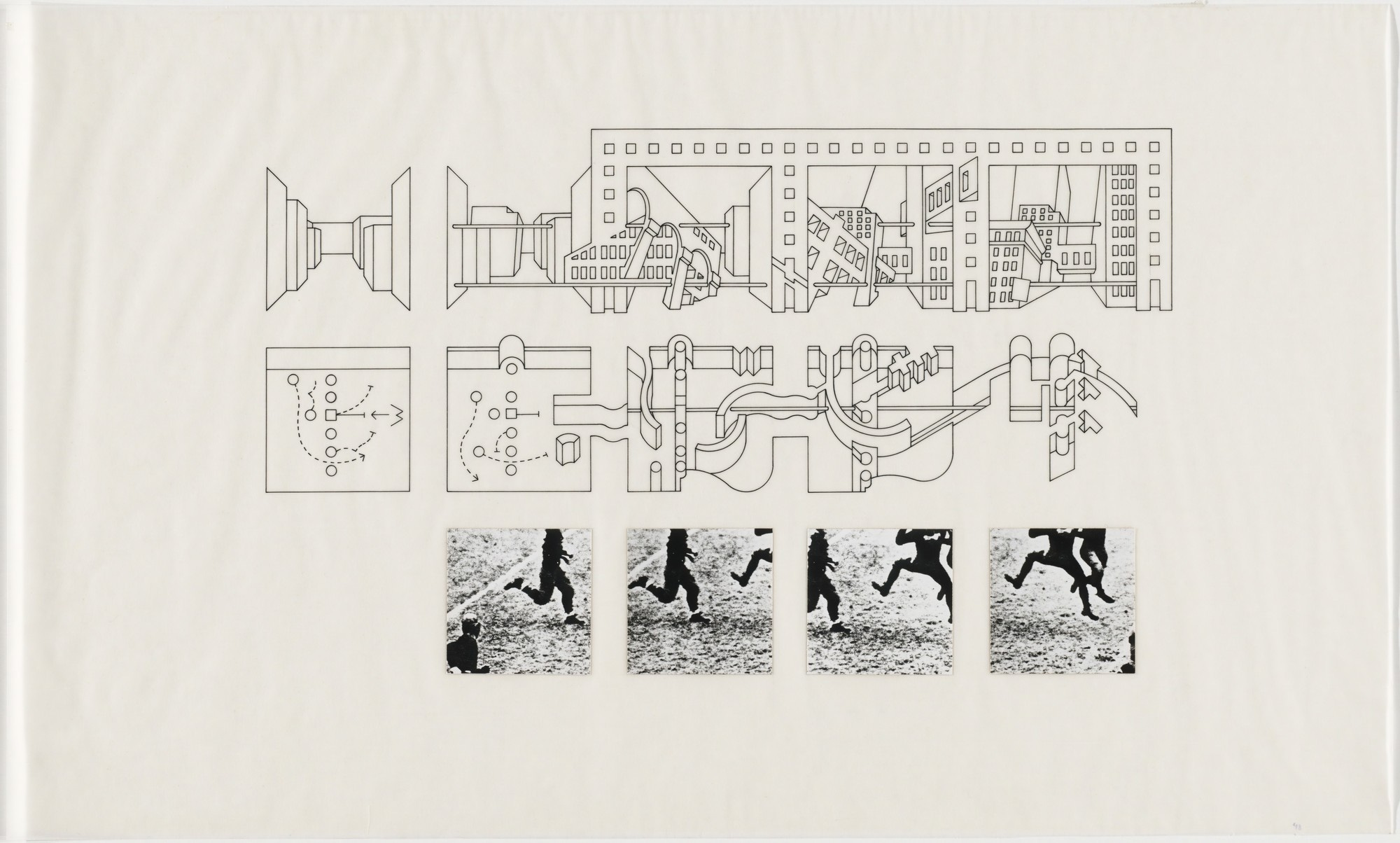
The ironically labelled ‘work in progress’ documentation that Tang refers to, and which he takes pains to contrast from the work shown, describes the idiosyncratic practice of diagramming in the architectural profession. Unlike the more traditional forms of architectural drawing which depict the actual design, such as plan, section and elevation, diagram drawings seek to explain the logic behind a project. Diagrams might be used to isolate and convey some key feature of the design, or to record the different decisions made as a design was developed. I say “was developed” in the past tense, as more often than not, these drawings are heavily curated and produced retroactively, after the design is complete. Usually, they are created either for public exhibitions, publications or client/competition presentations. As I write this, the diagrammatic drawings of Peter Eisenman, or more abstractly, Bernard Tschumi, come to mind.
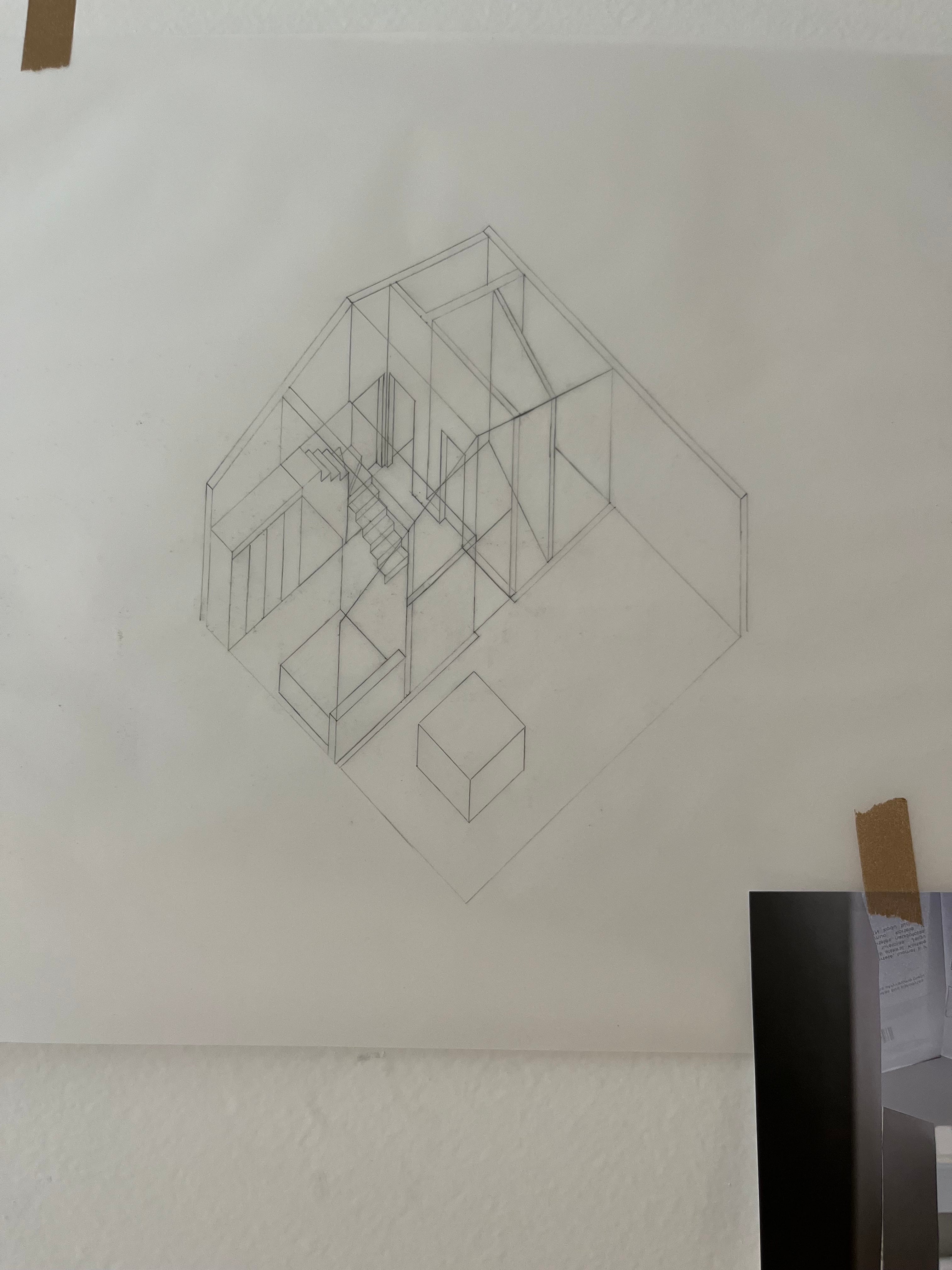
By contrast, the “live projective entities” featured in the exhibition are neither the neatly curated diagrammatic explanations of some design, nor are they created in retrospect to the completion of a project. Instead, the various drawings, images and models shown, have a generative and functional quality. They act as a precursor, or intermediary step, before ideas are “finalised” in the more traditional forms of architectural drawing (plan, section, elevation, etc.). You might say that they are the active schema of an unfolding design, being used as a vehicle through which concepts are fleshed out. As such, they make little effort to explain themselves clearly. Rather they prototype and explore concepts, embodying the intellectual labour of the architect.
Later in the introduction, Tang writes “curiously, the architects here seem to reflect a commitment to a belligerently analogue, at times clumsy, way of working.” I find this description to be particularly decisive. The works shown are sketchy and imprecise. Often, they are drawn with pencil or made with foamcore and cardboard. They are all variously presented on pieces of tracing paper informally taped to the wall, or propped up on cheaply made cardboard plinths. Importantly, the measured precision of digital drawing is nowhere to be found.
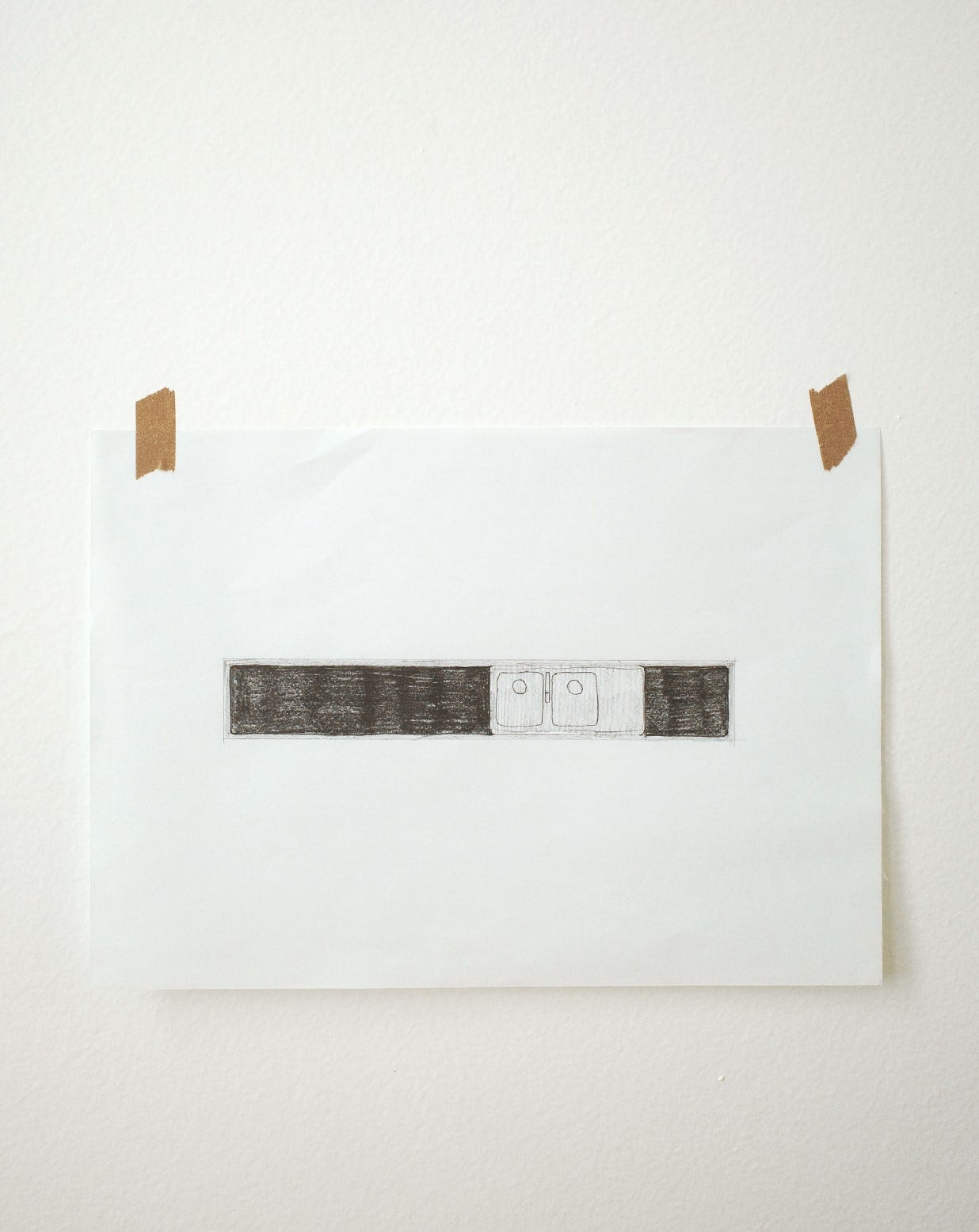
Pointing out this imprecision is not a declaration that the work lacks aesthetic merit. In fact, whether or not they aspire to it, the drawings are very beautiful. There is an organic richness to the wonky, smudged lines, and a surprising degree of careful intention to be found in each sketch. It may appear “clumsy”, but it is certainly not flippant.
However, beyond their aesthetic qualities, what is most salient about these drawings is the disposition they pose towards design. The decision to be “belligerently analogue” isn’t an inconsequential choice. Rather it seems to directly shape the proposed architecture. Rejecting the use of digital drawing technology, in favour of analogue hand drawing, closes off certain possibilities to a designer, yet at the same time, it opens up others.
Analogue drawing, especially the clumsy practice of freehand sketching, involves an embrace of informality and approximation. As a process, it is inherently looser and less formally rigid than drawing using drafting software. There is a certain fluidity to the creation of a hand drawn sketch. In the place of intense precision, the design becomes imbued with the quality of plasticity. Works become mutable, loose, freeform and surprising, even if it is only in a subtle way.
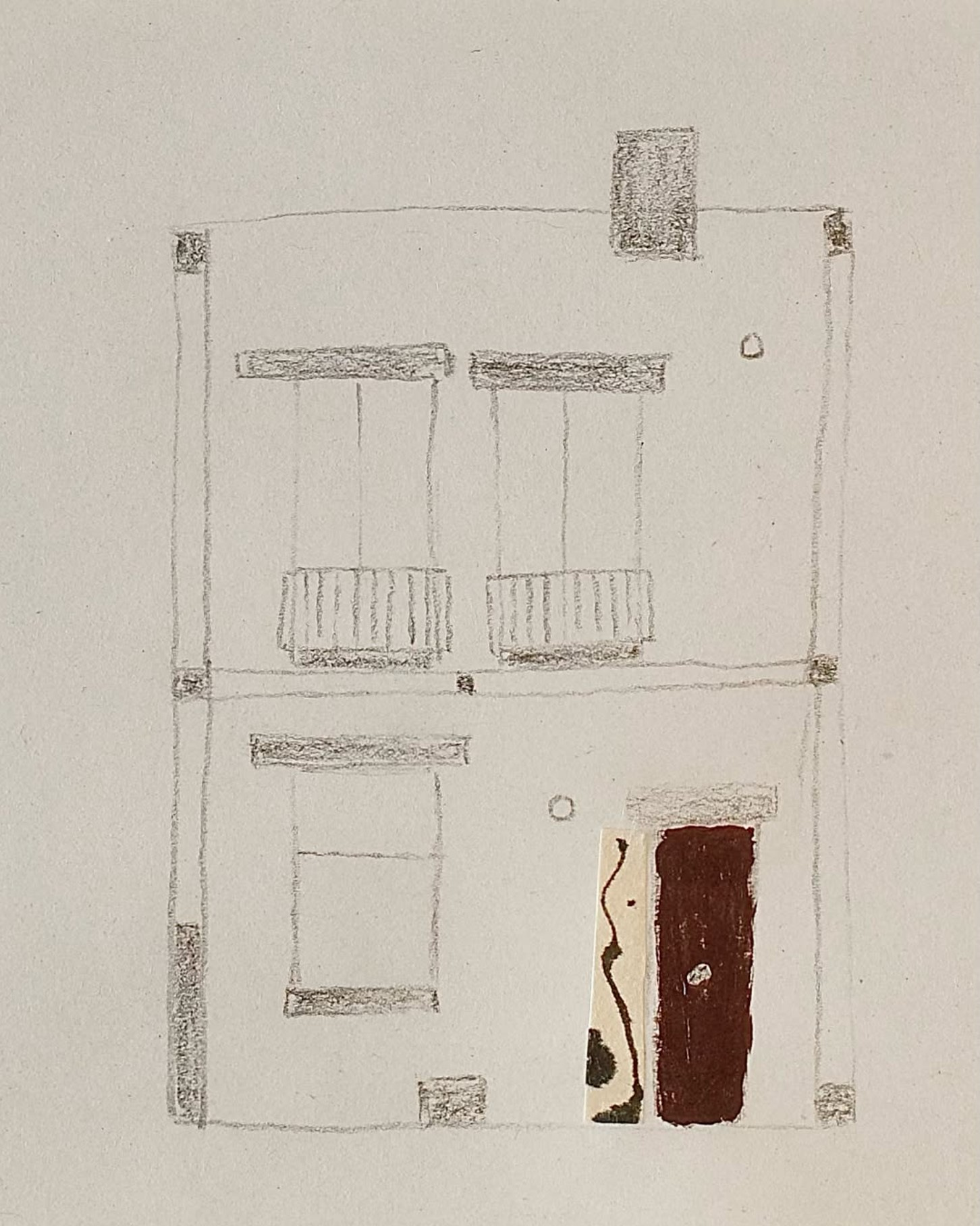
Here, intuition becomes something of a guiding principle, or at least a framework. Even for designers who work with formal rules, such as proportion or symmetry (or asymmetry, for that matter), analogue drawing engenders something of an intuitive disposition. Nothing has been measured yet, and spatial or built gestures are free to occur without the sluggish constraints imposed by software. Columns are placed ‘just there’, door frames are ‘wide enough’ and perhaps ‘unusually tall’, we have to accept that the window on the far wall is ‘large enough to fill the space with light’, but ‘too high to see out of’. What really matters is how these elements relate to each other, as well as how they relate to the building’s inhabitants and to the site. Exploring an intuitive, clumsy and mutable relationality appears to be the very purpose of these drawings.
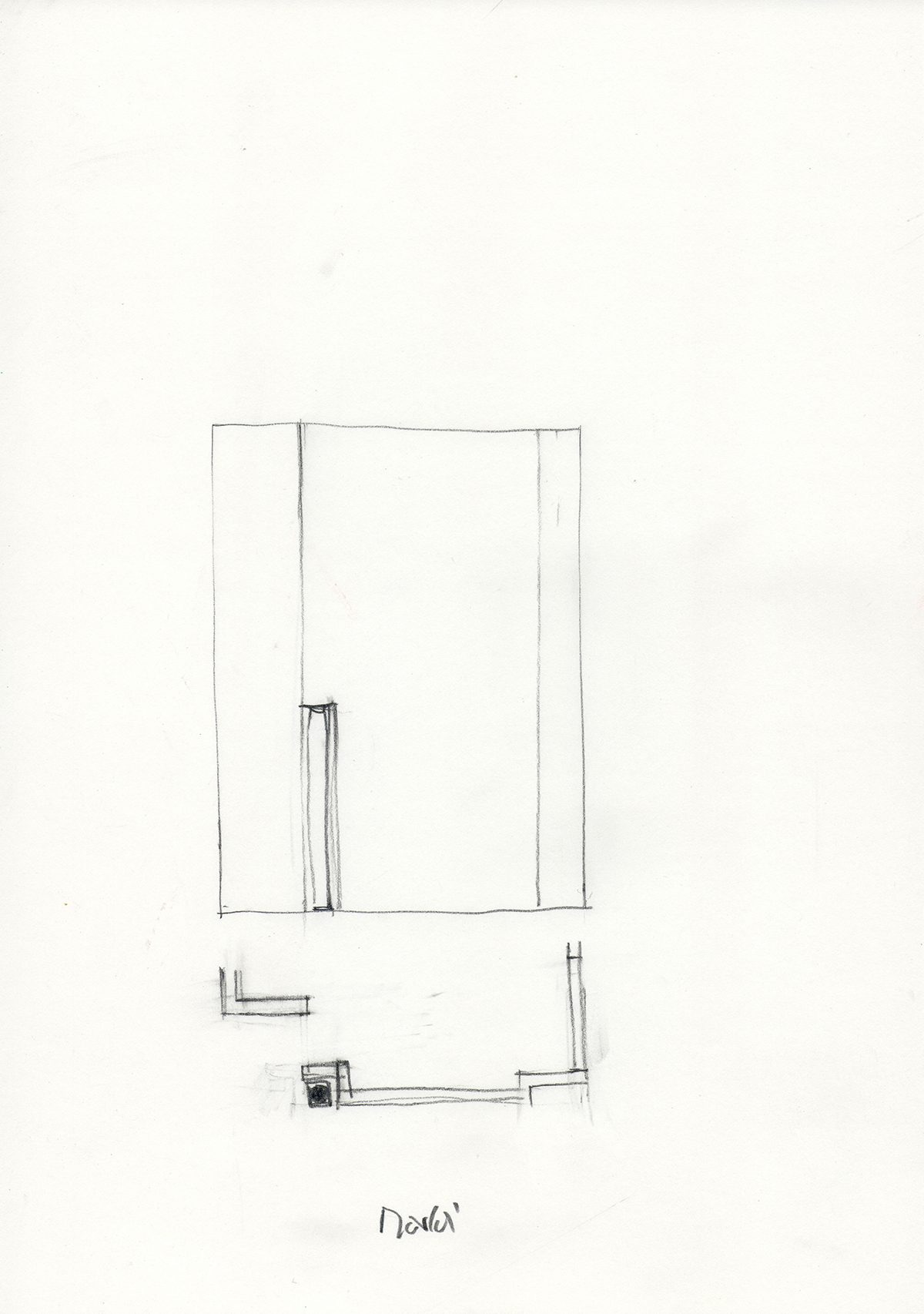
It is likely that this specific style of analogue drawing stems, in some way, from the work of Swiss architect, Peter Märkli. At the very least, he is a reference for the designers hosting the exhibition. Something of a cult figure among architects, Märkli has produced a series of celebrated freehand sketches, roughly dating back to the 2000s, that he calls ‘language drawings’. Much like the sketches in the exhibition, language drawings are clumsy, organic and are deliberately arranged without the precise use of scale or measurement. Usually, they are drawn in elevation, directed front-on at the façade of a building (sometimes with an accompanying plan view). Despite their initially crude appearance, they manage to express a rather intricate spatial arrangement of elements through a play of surface and depth.
Similarly, the purpose of language drawings is to elaborate a sense of complex relationality between design elements. In Märkli’s words, they help realise what he calls a “spatial gestalt”, a relation of all spatial parts to each other, and to an overall architectural ‘whole’.
In recent years I have noticed a surge of architects also embracing the use of these clumsy, almost childlike, hand drawn sketches. As I scroll through my Instagram newsfeed, I see instances of this practice by Nuno Melo Sousa, Jo Tailleu, or students of Jonathan Sergison’s studio at USI in Mendrisio. Its use seems to inhere in something of a loosely defined contemporary approach to architecture, that nebulous ‘shared style’ I mentioned earlier. Perhaps the consistent use of these sketchy analogue drawings provides us with some insight into the workings of this style? While architectural outcomes seem to vary between different contemporary designers, many choose to show their work through stylistically consistent imagery, as if they are expressing an unspoken, yet shared, design ethos.
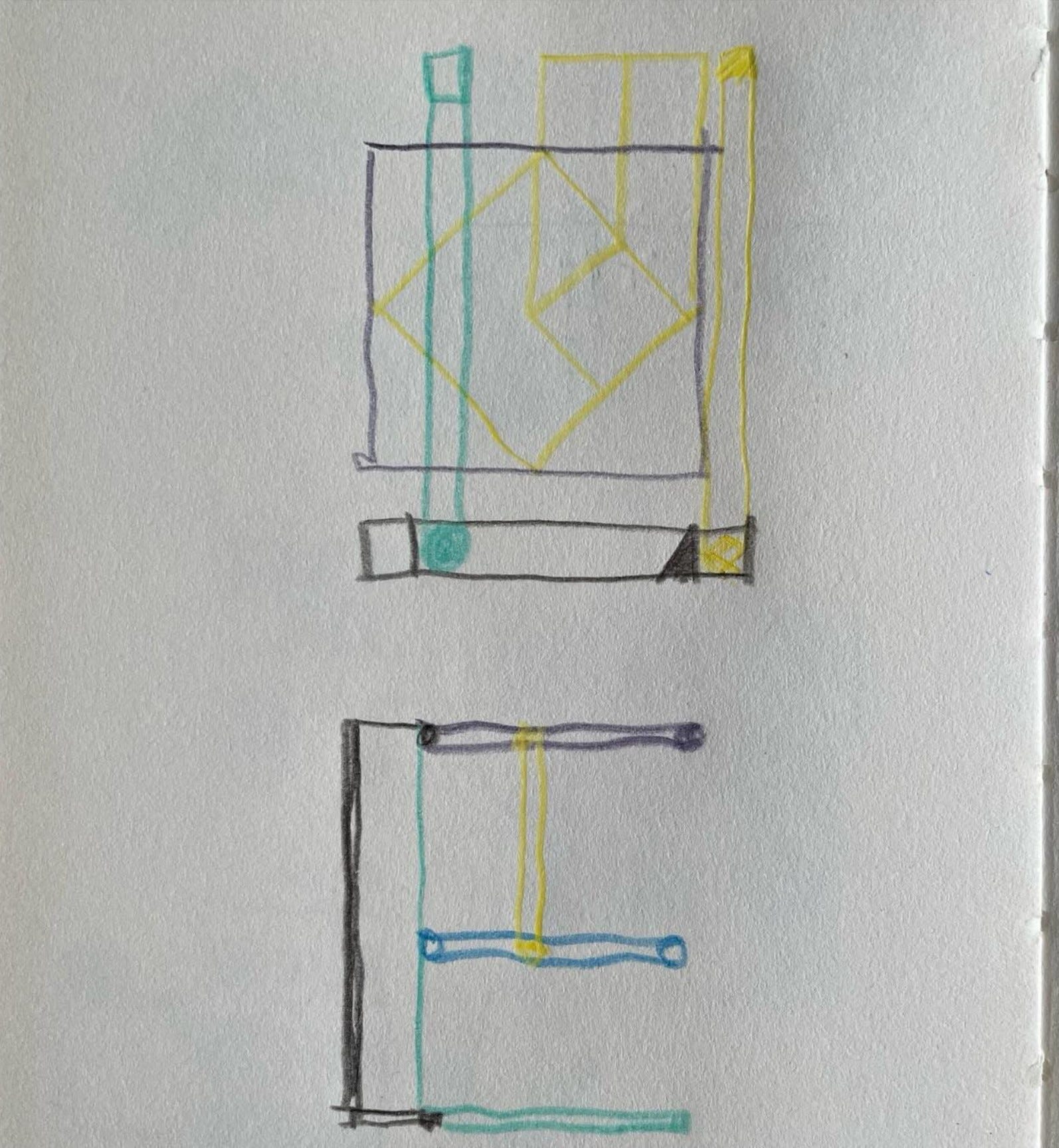
When I encounter these “belligerently analogue” drawings, however, it is not only their relational character, and their stylised informality, that captures my attention. In each of these drawings, and the designs that they depict, a poetic trace of their creation becomes apparent. It can be seen through their clumsiness, through the lines that can never be straight, the angles that are never truly 90°, through their inevitably imperfect shading. All of these small accidents serve as a record of the body of the architect. A hand that shudders slightly as it traces a line, an arc that is warped from being drawn too fast, a smudge left by a forearm as it rests on a part of the sketch. In this way, the body that produced the drawing becomes embedded in the work, giving shape to the ensuing architecture.
It is through engaging the design with the body, through understanding what it means to have a body and to navigate the world in a body, that a sense of poeticism erupts in the architecture itself. It is translated by the hand into the drawing, and through the drawing into the design of the building. The spirit that animates the body, the vulnerabilities that restrict it, the ideas, the carefulness, the intimate desire to provoke some kind of delight, all of it is channelled through the clumsy imperfect hand as it draws.
This piece really made me wonder about the stories held within those old buidlings. It's so vivid! Thank you for bringing such a rich sense of history to life.